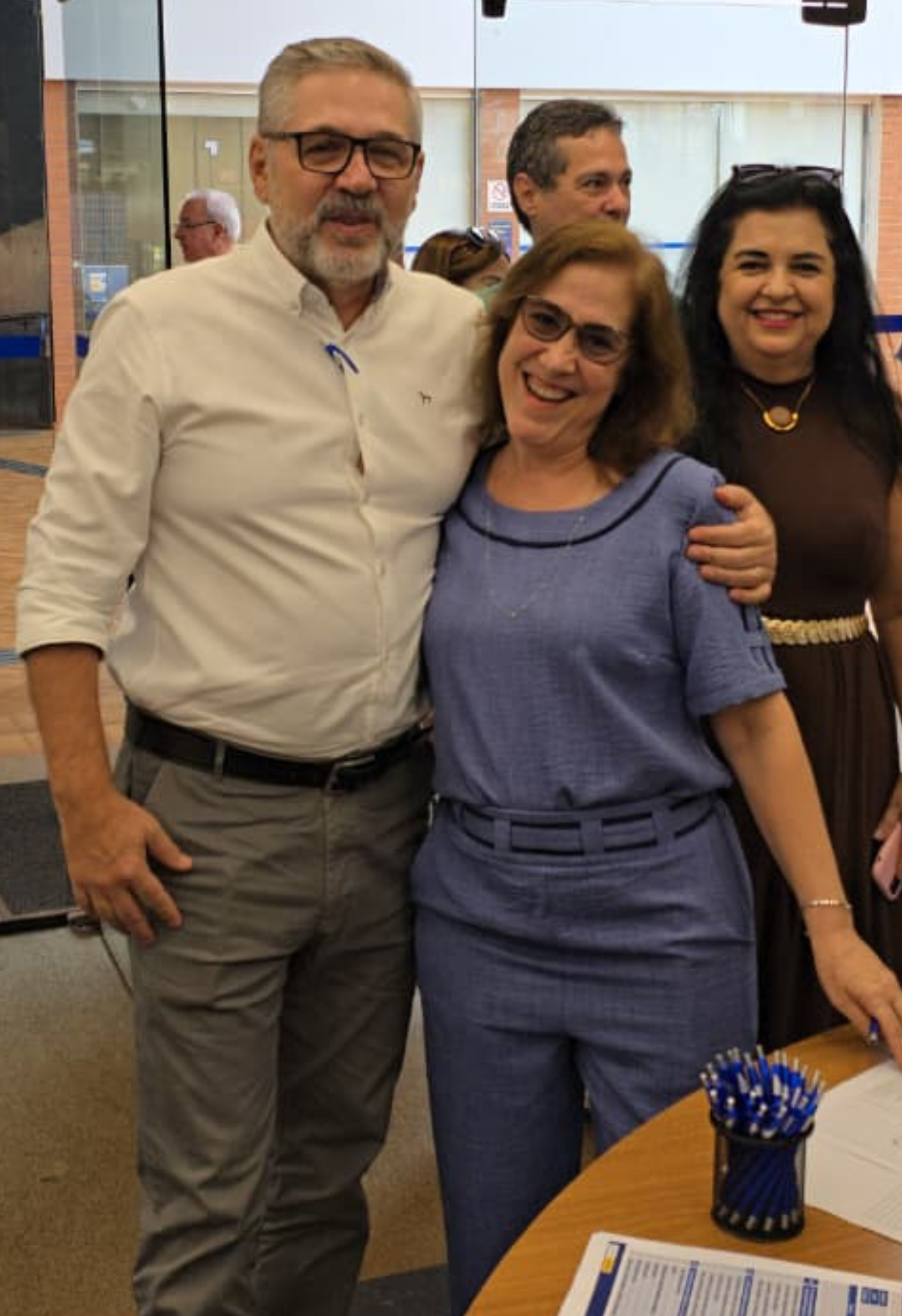










Law students from UNAERP Guarujá simulated a session of the United Nations (UN) Security Council. The practical activity corresponded to an academic project in the General Theory of the State and Political Science course, taught by Prof. Me. Flávia Martins. The coordinator of the Law program, Prof. Dr. Rodrigo Fernandes also followed the practical activity
The Security Council is the only decision-making space of the UN, acting on sovereign and specific decisions, especially regarding to security and the imminence of international conflicts. The practical exercise involved students from the 2nd period of the program in a complete experience, in which they simulated – as representatives of member countries – the actions of opening speeches in multiple languages, including Portuguese, Spanish, English, Japanese, Italian, Russian, Arabic and Indonesian language, in addition to proposing debates and voting.
The Law program coordinator, Prof. Dr. Rodrigo Fernandes, explains that the activity was able to bring the general public closer to the modus operandi of global governance performed by the United Nations. “In addition to enabling the student to understand in practice what they saw in theoretical knowledge, it was an activity that contributed to the community in which the program is located. This is part of global citizenship, in which everyone needs to have a certain amount of discernment.”
The Law program coordinator, Prof. Dr. Rodrigo Fernandes, explains that the activity was able to bring the general public closer to the modus operandi of global governance performed by the United Nations. “In addition to enabling the student to understand in practice what they saw in theoretical knowledge, it was an activity that contributed to the community in which the program is located. This is part of global citizenship, in which everyone needs to have a certain amount of discernment.”
Prof. Me. Flávia Martins emphasizes the importance of simulation for the daily lives of future Law graduates. “This action is important as it boosts each student’s understanding of countries foreign policy, enabling them to build their worldview, having the perspective of the way each country interacts in Political Science.”